Best Pokies in South Australia: Venues and Access
 Available in US
A practical look at venues, casino access, closing hours, payments and the limits of payout percentages.
Table of Contents
- South Australia’s Pokies Scene in 2026: Venues, Hours and the Local Vocabulary
- Online Pokies and Casino Access: What South Australian Players Are Actually Offered
- The Late-Night Question: 24-Hour Pokies, Clubs and South Australia’s Closing Hours
- Cashless Pokies in South Australia: Casino Play, Payments and Player Controls
- Finding Pokies Near South Australia Airport or Central Locations
- South Australia Pokies Payout Percentage: What RTP Can and Cannot Tell You
- Best-Paying Pokies in South Australia: Variance Matters More Than the Label
- Online Pokies Near South Australia: Why Location Does Not Create a Local Licence
- Pokies at Crown Casino South Australia: Untangling the Name and the Venue
- Pokies Open Until 5am in South Australia: The Promise Hidden in the Clock
South Australia’s Pokies Scene in 2026: Venues, Hours and the Local Vocabulary
South Australia’s pokies scene is primarily a land-based one: gaming rooms attached to licensed venues, clubs and casinos, each operating within its own conditions. The phrase “best pokies in South Australia” therefore sounds more definite than the local landscape really is. It may refer to a preferred venue, a familiar machine, convenient opening hours, or simply a place where the atmosphere feels less hurried. There is no universal title waiting to be crowned the best.
In Australian English, pokies is the ordinary word for gaming machines. “Slots” is understood, particularly in international casino language, but it sounds less local. “Slot machines” is even more clearly imported vocabulary. Official and regulatory material may use EGMs, meaning electronic gaming machines. On the floor, however, the language is simpler: pokies.
That distinction matters because words carry geography. In South Australia, a search for pokies venues generally points towards physical places rather than a category of internet entertainment. The venue is part of the product: its location, food and drink service, membership arrangements, atmosphere, and the hours during which the gaming area operates. The machine is only one part of the evening, though it is the part with the lights.
What “pokies” means in South Australia
Pokies are electronic gaming machines designed around reels, symbols, paylines or other game features. The local vocabulary does not change the underlying mathematics. Whether a machine is called a pokie, an EGM or a slot, each spin is independent. A previous result does not improve or weaken the next one.
That is an unromantic fact, which is precisely why it survives so well. A run of losses is not evidence that a machine is “due”, and a recent win does not make it favourable for the next punter. The machine has no memory of the room, the previous player or the length of the session.
Nor does the word “best” establish a measurable advantage. A machine’s RTP, or Return to Player, is a long-term theoretical average rather than a promise about an individual visit. It cannot predict what happens during one session. Volatility also changes the shape of results: high-volatility pokies tend to pay less frequently but in larger amounts, while low-volatility pokies tend to pay more often in smaller amounts. Neither description turns chance into a schedule.

South Australian venues and the importance of hours
The practical question is often not which machine is superior, but whether a particular venue is open when play is wanted. South Australia pokies opening hours belong to the venue and its licence conditions, not to the word “pokies” itself. A club, hotel or casino may have different operating arrangements, and the gaming area may not mirror every other service offered on the premises.
That makes phrases such as “South Australia pokies open now” deceptively blunt. “Open” can mean the building is trading, the gaming room is accessible, or the relevant service is operating at that particular moment. Those are not necessarily the same thing. Public holiday arrangements, maintenance, private functions and venue-specific policies can also alter the practical answer.
The sensible habit is to treat hours as information requiring confirmation from the individual venue. A broad regional label cannot establish that a gaming room is operating late, early or continuously. Nor can the presence of pokies imply that every facility offers the same access.
For central Adelaide searches, the same principle applies. “Best pokies South Australia CBD” is often shorthand for a venue that is easy to reach, familiar, and open at a useful time. It is not a recognised ranking category. Proximity may matter more than a machine’s theme, especially when the evening is shaped by transport, hospitality and the simple wish not to cross the city for a room that has already closed.
What can reasonably be compared
Venue comparisons are more meaningful when they concern observable conditions rather than lucky stories. Location, published trading information, accessibility and the character of the venue are practical points. A claim that one machine “pays better” because someone collected a large win is not comparable evidence. Each spin remains independent, and a memorable result is still only a result.
The same caution applies to the phrase “best-paying pokies in South Australia”. RTP describes a theoretical long-run return, not a forecast for tonight. Volatility describes frequency and size, not whether a particular machine will produce a profit. The label on the cabinet may be colourful; probability remains stubbornly plain.
pokies Electronic gaming machines designed around reels, symbols, and paylines, commonly used in the Australian local vocabulary.
South Australia’s legal gambling landscape also includes land-based casinos, licensed bookmakers and lotteries. Those are distinct products, with different rules and experiences. A venue search for pokies should not quietly blur them together. Nor should “pokies” be treated as a guarantee of licensing, consumer protection or favourable odds simply because it is the familiar local term.
The regional scene in 2026 is therefore best understood as a network of physical venues with local identities and variable hours, rather than a single table of winners. The vocabulary is Australian. The machines are not sentimental. And the clock still belongs to the venue.
Online Pokies and Casino Access: What South Australian Players Are Actually Offered
For South Australian residents, the phrase “online casino” suggests a neat digital version of the local venue: a screen, a balance, a few real-money pokies, perhaps a familiar casino name placed above the door. Legally, the picture is less tidy. The Interactive Gambling Act 2001 is the main federal law governing online gambling in Australia, and it draws a firm line around casino-style games offered to Australians.
Real-money online casinos offering pokies to Australian customers are banned under that Act. There is no Australian licence for online pokies, and none has ever existed. That distinction matters more than the vocabulary. Calling a product “pokies”, “slots” or “casino games” does not alter its legal category, and a South Australian label does not turn a remote operator into a local one.
What is legally available online?
Australian residents can access some online gambling products that are permitted and licensable. These include pre-event sports and racing wagering, lotteries and keno. Online casino games, including real-money pokies, do not belong to that licensed domestic category.
That is why a search for South Australia casino online pokies can produce a confusing mixture of brands, review pages and offshore websites. The language may look local; the licence is not. An Australian-facing page is not evidence of an Australian casino licence, and there is no domestic register of online pokies operators to consult for reassurance.
The law targets the provider rather than the punter. Australians are not prosecuted under the Interactive Gambling Act for placing bets at offshore sites. Enforcement is directed at services that offer prohibited online gambling to people in Australia. Legal exposure and practical protection are therefore different questions, rather inconveniently refusing to share one answer.
Offshore access is not domestic licensing
Australian residents can legally play online pokies at licensed offshore casinos. Those operators may hold approval from a foreign jurisdiction rather than an Australian gambling authority. That can make the game accessible, but it does not make the platform a South Australian casino, nor does it provide the protections attached to a locally licensed online product.
The difference is easiest to see in the word “licensed”. A licence from an offshore regulator is a claim about that operator’s standing in the issuing jurisdiction. It is not an Australian licence for online casino games. Since no Australian casino licence exists for this product, any statement suggesting that an online pokie site is locally licensed should be treated as a basic factual error, not as polished reassurance.
Legal Status Real-money online casinos offering pokies to Australian customers are banned under the Interactive Gambling Act 2001.
This also applies to brand searches involving Crown. A name associated with a casino does not prove that a South Australian online pokies service exists under that name. Brand recognition, geographic wording and regulatory status are separate matters. A familiar sign can travel further than the law does.
Fairness, random numbers and the limits of a badge
Licensed Australian-facing platforms are required to use independently audited random number generators. That requirement concerns the technical operation of games: outcomes should be produced by a random system that has undergone independent auditing. It does not create an Australian online casino licence where none exists.
The same caution applies to game names and software providers. A pokie supplied by a recognisable developer can still appear through an offshore operator. The title may be familiar; the contractual relationship, dispute process and regulatory protections depend on the platform offering it. A well-known reel set is not a substitute for checking the operator’s actual licensing information.
No game label can promise a result. Each spin remains independent, and access to a game does not make a jackpot more likely in South Australia than elsewhere.
Deposits, withdrawals and bonuses
Payment language often makes offshore platforms sound more domestic than they are. A site may display Australian dollars, accept an Australian payment method or advertise a welcome offer for local customers. None of those features establishes Australian licensing.
The same principle applies to “no-deposit” and bonus claims. A promotion may remove an initial deposit requirement while attaching conditions to wagering, eligible games, withdrawals or expiry. It does not change the legal status of online pokies, and it should not be read as a consumer-protection guarantee. Clear terms matter precisely because attractive words are cheap.
For real-money play, identity checks and withdrawal conditions may also determine whether a balance can be released. The existence of a payment route is not proof that a platform is trustworthy, locally regulated or covered by an Australian self-exclusion system.
Self-exclusion across the border
Searches for self-exclusion pokies in South Australia often assume that one national mechanism follows a punter from venue to website. Offshore online casinos are not covered by BetStop or national self-exclusion registers. A self-exclusion tool offered by an individual platform may therefore operate only within that platform’s own system.
That leaves a serious gap between the language of protection and its reach. A local venue, a licensed wagering product and an offshore casino do not necessarily share the same controls. Deposit limits, account blocking and session reminders may exist on a platform, but their presence should not be confused with the protections of Australian casino licensing.
The practical map is therefore divided: domestic online casino pokies are not licensed or permitted for offering to Australians; offshore sites may be accessible and licensed elsewhere; and the player is not the enforcement target under the Interactive Gambling Act. Access exists. Local licensing does not.
The Late-Night Question: 24-Hour Pokies, Clubs and South Australia’s Closing Hours
The phrase “24-hour pokies” sounds more definite than it is. It can mean a venue that never closes, a machine room available late into the night, or merely a listing whose opening information has not kept pace with reality. In South Australia, those are different claims. A pokie may be operating legally in a land-based venue without the venue offering uninterrupted access to it.
Venue Hours Opening hours for gaming areas may differ from the general trading hours of a club, hotel, or casino.
That distinction matters most after midnight, when ordinary assumptions become unreliable. A club, hotel or casino may have its own trading hours, entry conditions and gaming-room arrangements. Public holidays, special events, licensing conditions and local operating decisions can alter the practical answer. “Open now” is therefore a time-sensitive statement, not a permanent feature of a venue.
Clubs, hotels and casinos are not interchangeable
South Australia’s land-based gambling landscape includes casinos and other licensed venues. Clubs and hotels may also be associated with pokies, but the word “club” does not create a universal late-night rule. Nor does the presence of electronic gaming machines mean that every part of a venue remains accessible whenever the machines are technically installed.
The setting changes the social meaning of the activity. A club presents pokies alongside membership, dining, sport or community routines. A hotel places them within a broader hospitality business. A casino is designed around gambling as its central attraction. The machine may be familiar in all three places; the timetable is not.
That is why a search for clubs with pokies in South Australia should be read as a request for venue information, not as evidence that clubs operate around the clock. The same caution applies to hotel pokies. A hotel’s bar, dining room and gaming area may not share identical access arrangements. One door being open does not settle the question.
What “open now” can actually establish
A current listing can help identify whether a venue appears to be trading, but it cannot by itself establish continuous gaming access. Opening information may refer to the main premises rather than the gaming area, and a venue’s displayed hours may not capture temporary restrictions.
A sensible late-night check separates several questions:
- Is the venue open at the relevant local time?
- Is the gaming area open, rather than only the bar or restaurant?
- Are entry or membership conditions relevant?
- Has the venue published a temporary change to its hours?
- Does the information come from the venue itself or from an outdated directory?
The wording is deliberately plain because the clock is not. A result marked “open” is not a licence to infer “pokies available all night”. It is only one piece of evidence about the premises.
The legal boundary does not move with the hour
Land-based casinos are among the legal options available to Australians, alongside licensed bookies and lotteries. Online casino games, including online pokies, are prohibited from being offered to people in Australia. A late hour does not turn an online casino into a local South Australian venue, and a local venue’s closing time does not make online casino play a substitute.
The permitted online gambling products are narrower: pre-event sports and racing wagering, lotteries and keno can be licensed. That boundary is easy to lose in the glow of a “play now” button, particularly when a website uses Australian language or displays local time. Geography in the wording is not the same thing as a South Australian venue.
Payment rules reinforce the separation. A specialist industry overview reports that, since 11 June 2024, credit cards, credit-related products and cryptocurrency have been banned as payment methods for online wagering in Australia. That information concerns online wagering payments; it does not tell a late-night visitor when a club, hotel or casino closes, nor does it turn prohibited online pokies into a legal local option.
Important Distinction Proximity and brand names do not equate to local licensing or regulatory protection.
Why a genuine 24-hour claim needs evidence
A venue that truly offers uninterrupted access should be able to state that arrangement clearly through current official information. Without that confirmation, “24-hour” is best treated as an unverified description. It may describe the building, a reception desk or a directory category rather than the pokie area itself.
The north of South Australia presents an additional practical complication: distance can make stale information more costly. A mistaken assumption about late access is not merely inconvenient when the next venue is far away. Local confirmation becomes more valuable as travel time grows, particularly outside major urban centres.
None of this makes late-night play mysterious. It makes the claim narrower. A venue may be open late without being open all night; a club may have pokies without offering unrestricted access; an “open now” marker may be accurate for the premises while saying nothing precise about the machines.
The clock answers one question. Only one.
Cashless Pokies in South Australia: Casino Play, Payments and Player Controls
Cashless play changes the way money reaches a pokie, not the underlying mathematics of the game. In a South Australian casino, the relevant distinction is between using a digital payment or player account within a physical venue and opening an online casino account from home. Those are not interchangeable arrangements, however similar the screens may look.
A casino-based cashless system can reduce reliance on notes, coins and ticket handling. It may also connect play with identity checks, account records and safer-play controls. That administrative layer matters. A machine does not become safer merely because the cash is invisible.
What “cashless pokies” can mean
The phrase can describe several different arrangements:
- a venue account used to load funds onto a pokie;
- carded play that associates activity with a registered patron;
- a digital wallet or approved payment process connected to casino play;
- online real-money pokies accessed through a website or app.
The last item belongs to a different legal category. Under the Interactive Gambling Act 2001, real-money online casinos offering pokies to Australians are banned. The Act is Australia’s main federal law governing online gambling, and it distinguishes online casino products from permitted forms of wagering. A cashless experience inside a licensed physical casino must not be used as a linguistic shortcut to suggest that online pokies are domestically licensed.
That is the small trap in the phrase “online pokies South Australia”. Geography describes where the person is sitting. It does not create a South Australian online casino licence.
Payments and the PayID boundary
PayID is an Australian payment method linking directly to an Australian bank account. It does not charge players a transaction fee, and deposits settle instantly without the card-processing delay associated with a card payment. Those features can make PayID relevant to a cashless account, where the operator actually supports it and the transaction is permitted.
The boundary is more important than the convenience. A payment rail does not legalise the product attached to it. PayID can move money; it cannot turn an online casino into a locally licensed service.
A payment-compliance summary from a specialist industry review states that, since 11 June 2024, credit cards, credit-related products and cryptocurrency have been banned as payment methods for online wagering in Australia. That restriction should not be blurred with the separate question of whether pokies may be offered online. The product and the payment method must each be assessed.
A system used to load funds directly onto a physical pokie machine.
Activity that associates machine use with a registered patron.
An approved payment process connected to casino play.
Identity, records and player controls
Cashless casino play generally makes identity more visible than anonymous cash inserted into a machine. A venue may need to establish who holds the account, connect play to that identity and maintain records for compliance. The practical result is less mystery and more paperwork—the traditional price of turning loose cash into a managed system.
Player controls can include deposit limits, self-exclusion and session time reminders where the relevant licensed platform or venue provides them. These tools are meaningful because they interrupt the effortless rhythm that cash and machines can create. They are not proof that a game is favourable, nor do they alter the outcome of a spin.
The same principle applies to maximum bet settings. A max bet pokie is simply a game or configuration allowing a larger permitted stake; the label says nothing about legality, fairness or better odds. Bet size does not make a jackpot more certain. It only changes the amount placed at risk on that independent spin.
For South Australia casino pokies, the useful questions are therefore concrete: who operates the venue, what account or payment process is being used, what identity checks apply, and which controls can be activated or enforced? “Cashless” answers only the handling-of-money question.
A digital trail remains a trail.
Finding Pokies Near South Australia Airport or Central Locations
Location can be useful, but it is a blunt instrument. “Near South Australia airport” may mean a venue within a short taxi ride, somewhere on the route into Adelaide, or simply a destination that is easier to reach from the terminal than from an outer suburb. “Central” is just as elastic: a city-centre address, a nearby club, or a casino reached by public transport may all appear in the same mental map.
That makes proximity a starting point, not proof of availability.
Reading the map without inventing a venue
A sensible comparison separates three questions:
- Is the venue physically convenient from the airport or central district?
- Is it a land-based gambling venue rather than an online service?
- Are its current operating conditions confirmed by the venue itself?
The first question belongs to geography. The second matters because online casino games, including pokies, are prohibited from being offered to people in Australia. Legal ways to play include land-based casinos, licensed bookies and lotteries. A website using “South Australia” in its title does not become a local venue, and a location pin does not create an Australian online casino licence.
The third question is where neat travel plans tend to meet ordinary reality. A map may show a venue while saying little about entry requirements, temporary closures, gaming-room access or whether the listed information is current. Distance alone cannot settle those details.
Airport versus central Adelaide
For airport-based travel, the most practical measure is often the whole journey rather than the straight-line distance. Traffic, road access and the final walking route can matter more than a venue appearing close on a map. A central location may be easier to reach once transport links are considered, even when it is not the nearest point geographically.
Venue Check
Central searches also need a distinction between a casino and a club or hotel with EGMs. They are not interchangeable simply because both may contain pokies. Their setting, admission arrangements and local operating conditions can differ. A tidy label hides a great deal.
The reliable approach is restrained: identify the type of venue, confirm its address through an official channel, and check current access information before setting out. No invented shortlist is safer than a precise-looking one assembled from stale map data. Availability is a location question. Legality is another. The two should not be made to share a postcode.
South Australia Pokies Payout Percentage: What RTP Can and Cannot Tell You
The phrase “payout percentage” sounds reassuringly precise. In South Australian pokies, the more useful term is RTP, or Return to Player. It describes the theoretical share of stakes a game would return over an exceptionally long sequence of play. It does not describe what a particular pokie will return during one visit, one evening, or one memorable run.
That distinction is easy to lose. A published RTP is not a promise attached to every spin. It is a statistical model applied across many outcomes. A session can finish below that long-term figure, rise above it, or produce no meaningful pattern at all. The machine has no obligation to balance the books while someone is watching.
Why individual spins remain separate
Every spin is independent. A win on the previous spin does not make another win more or less likely, and a stretch without a payout does not create a debt that the game must repay. The reels do not remember disappointment.
This matters when interpreting claims about South Australia pokies payout percentages. RTP can help compare the theoretical design of games, but it cannot predict the next result or identify a “due” machine. Past performance in a session is not evidence of a changed probability.
Licensed Australian-facing gambling platforms are required to use independently audited random number generators. That addresses whether outcomes are produced through a tested random process; it does not turn RTP into a personal forecast.
RTP is not the whole risk picture
Two pokies may have a similar theoretical RTP while feeling entirely different in practice. Volatility describes the shape of those results: high-volatility games tend to pay less frequently but in larger amounts, while low-volatility games tend to pay more often in smaller amounts. RTP concerns the long-run average; volatility concerns how unevenly that average may arrive.
So a payout percentage is best treated as a specification, not a verdict. It can inform comparison, but it cannot promise a profitable session, a particular win, or a result on demand.
Best-Paying Pokies in South Australia: Variance Matters More Than the Label
This shortlist highlights operators worth considering when exploring the best pokies available to South Australian players in 2026. Use the details below to identify platforms whose licensing, bonuses, deposit requirements, or payment features match your preferences.
License: Curacao eGaming Licence · Min. deposit: A$10 WinSpirit is a Curacao eGaming-licensed operator with a low minimum deposit of A$10, making it a straightforward option for players who prefer to start with a modest amount.
License: Curacao eGaming Licence · Min. deposit: A$10 PlayCroco holds a Curacao eGaming Licence and accepts deposits from A$10. It is notable for combining recognised offshore licensing with a low entry point.
License: Curacao · Bonus: up to A$2,000 Golden Pokies operates under a Curacao licence and features a bonus of up to A$2,000. Its main appeal in this shortlist is the headline value of its promotional offer.
License: Curacao (operating since 2017) · Bonus: 250% up to A$2,000 + 50 free spins on the first of six deposits · Min. deposit: A$20 Uptown Pokies has operated under Curacao licensing since 2017. Its offer includes 250% up to A$2,000 plus 50 free spins on the first of six deposits, with a minimum deposit of A$20.
License: Curacao eGaming (Hollycorn N.V., since 2017) · Bonus: 225% up to A$1,540 + 600 free spins across 4 deposits, 20x wagering · Min. deposit: A$20-30 (depends on the offer) Playfina Casino operates under Curacao eGaming through Hollycorn N.V. and has done so since 2017. It offers 225% up to A$1,540 and 600 free spins across four deposits, with 20x wagering and a minimum deposit of A$20–30 depending on the offer.
License: Curacao Gaming Control Board OGL/2023/176/0095 (Hollycorn N.V.) · Bonus: up to A$5,000 + 300 free spins across 4 deposits Rollero Casino is licensed by the Curacao Gaming Control Board under OGL/2023/176/0095 through Hollycorn N.V. Its promotion offers up to A$5,000 plus 300 free spins across four deposits.
License: Curacao Gaming Control Board OGL/2023/174/0082 (Dama N.V.) · Bonus: up to A$5,000 + 300 free spins across 4 deposits SpinsUp holds Curacao Gaming Control Board licence OGL/2023/174/0082 through Dama N.V. It stands out for a bonus of up to A$5,000 and 300 free spins distributed across four deposits.
License: international iGaming licence – jurisdiction not named in the source · Bonus: 100% up to A$1,000 + 100 free spins, 35x wagering · Payout speed: PayID 1-24 hours · Min. deposit: A$30 (PayID from A$10) House of Pokies operates with an international iGaming licence, although the source does not name the jurisdiction. It offers 100% up to A$1,000 plus 100 free spins with 35x wagering, while PayID payouts are stated as taking 1–24 hours.
License: Curacao – Antillephone N.V. (Versus Odds B.V.) · Bonus: up to EUR 2,000 across 5 deposits + 200 free spins · Min. deposit: EUR 20 Thor Casino is licensed in Curacao by Antillephone N.V. for Versus Odds B.V. Its promotion provides up to EUR 2,000 across five deposits plus 200 free spins, with a minimum deposit of EUR 20.
License: Curacao · Bonus: up to A$10,000 multi-stage + 500 free spins · Min. deposit: A$20 (POLi) Lucky Dreams operates under a Curacao licence and offers a multi-stage bonus of up to A$10,000 with 500 free spins. The minimum deposit is A$20 when using POLi.
“Best-paying” sounds precise, but it rarely is. A pokie does not become superior because a recent result was generous, and a machine that has been quiet has not somehow stored up a win. Each spin is independent. The previous outcome has no bearing on the next one.
A more useful distinction is volatility. It describes the shape of a game’s results rather than promising a particular return:
- High-volatility pokies tend to pay less frequently, with larger amounts when winning combinations appear.
- Low-volatility pokies tend to pay more frequently, but in smaller amounts.
Neither category is automatically the best-paying choice. It depends on what “best” is being made to mean: larger occasional prizes, more regular small returns, or a theoretical long-term average. Those are different measurements, despite the tidy language used around them.
What the label leaves out
RTP, or Return to Player, is a long-term theoretical average. It is not a session forecast and cannot tell an individual punter what will happen during a particular run of spins. A game can produce a disappointing session while still carrying its stated RTP, because that figure only becomes meaningful across a very large number of independent outcomes.
Volatility adds the missing texture. Two pokies may appeal to entirely different temperaments while offering no certainty of profit. One produces longer stretches without a notable payout; another produces smaller returns more often. The mathematics is less glamorous than the word “best”. It is also more honest.
Volatility vs RTP While RTP (Return to Player) provides a long-term theoretical average, volatility determines the frequency and size of payouts. High-volatility machines pay less often but in larger amounts, whereas low-volatility machines pay more frequently in smaller amounts.
The same logic applies online and in a venue. “Pokies” and “slots” are local variations in terminology, not different mathematical species: both use reels, RTP and volatility. Location does not turn a particular title into a better-paying game.
For South Australian players comparing titles, the sensible question is therefore not which machine has recently paid the most. It is which published characteristics are being examined, and whether volatility is being confused with a promise. There is no winning label. Only measurable behaviour.
Online Pokies Near South Australia: Why Location Does Not Create a Local Licence
“Near South Australia” sounds like a geographical promise. For online pokies, it is mostly a grammatical one. A website may use South Australian currency, mention Adelaide, or display Australian-friendly payment language while operating from another jurisdiction. None of those details creates a South Australian licence.
The governing line is drawn by the Interactive Gambling Act 2001, Australia’s main federal law for online gambling. Real-money online casinos offering pokies to Australians are prohibited. Online casino games, including pokies, cannot lawfully be offered to people in Australia simply because the operator is close by, accepts Australian residents, or has built a page using local wording.
Proximity is not regulation
A physical venue can be near a South Australian address. An online operator has no meaningful local address in the same sense. Its servers, company registration, support team and regulator may all sit elsewhere, and the distance between them says little about the legal position of the service.
That distinction matters because “Australian-facing” and “Australian-licensed” are not interchangeable descriptions. There is no Australian licence for real-money online pokies. The words “South Australia” on a landing page therefore do not establish licensing, approval, fairness oversight or local consumer protection.
The same caution applies to familiar language. “Pokies” is the natural Australian term for gaming machines, but using it online does not turn an offshore casino into a domestic gambling service. A local accent is not a licence.
What the wording can and cannot tell you
A location label may describe intended audience rather than lawful authorisation. It may indicate that a platform accepts Australian registrations or presents prices in Australian dollars. It does not alter the prohibition on offering online casino games to people in Australia.
The legal risk under the Act is directed at the provider, not the individual punter. That does not transform an offshore site into a locally regulated option; it merely identifies who the legislation targets. Geography remains scenery. Regulation is the substance.
Is there an Australian licence for online pokies?
No, there is no Australian licence for online pokies, and real-money online casinos offering them are prohibited under the Interactive Gambling Act 2001.
Does a brand name like Crown guarantee a local service?
No, brand recognition is separate from regulatory status; a familiar name does not prove a local South Australian online service exists.
Pokies at Crown Casino South Australia: Untangling the Name and the Venue
The phrase “Crown Casino South Australia” sounds more certain than it is. Crown is a prominent casino brand, but a brand name alone does not establish a South Australian venue, a local pokie room, or a legal online service. Regional wording can quietly turn recognition into geography. Search language is very good at that sort of magic.
For South Australian punters, the important distinction is between a land-based casino and an online site using Crown-like language, branding, or regional references. A physical casino may be a lawful place to play pokies where the relevant state rules permit it. That does not mean every venue associated with a familiar national brand exists in South Australia, nor that a website presenting itself as local has an Australian casino licence.
Brand recognition is not a venue listing
A casino name should be checked against the actual location and operator, not treated as proof of a nearby destination. Crown branding may be associated with casinos in other parts of Australia, while a South Australian page can use the wording simply because people connect “Crown” with casino pokies. The association is understandable. It is not evidence.
The same caution applies to websites. Under the Interactive Gambling Act 2001, real-money online casinos offering pokies to Australians are banned. Online pokies are prohibited from being offered to people in Australia, regardless of whether a page uses South Australian wording or displays a familiar casino identity.
That leaves a clean legal distinction:
- Land-based casinos are among the legal gambling options available to Australians, subject to the relevant local rules.
- Licensed bookies and lotteries are also legal options.
- An online casino cannot become lawful for Australian customers merely by borrowing a recognised brand or adding “South Australia” to its page.
The practical question is therefore not whether the word Crown appears beside pokies. It is whether there is a verified physical venue in the relevant location, and whether the product is being offered online in a way Australian law permits. Names attract attention. They do not issue licences.
Pokies Open Until 5am in South Australia: The Promise Hidden in the Clock
A claim that pokies operate until 5am in South Australia is first a question about a particular venue’s approved trading hours. The presence of electronic gaming machines does not extend those hours, and a listing that says “open late” does not establish access throughout the night. Hours may apply to the venue, the gaming area, or a special trading arrangement. Those are not interchangeable.
The clock also creates a misleading sense of certainty. A venue may close earlier on some days, restrict gaming after a stated time, or change its schedule without the machine itself changing in any way. “Open until 5am” therefore needs to be treated as a claim requiring current confirmation from the venue, not as a general feature of South Australian pokies.
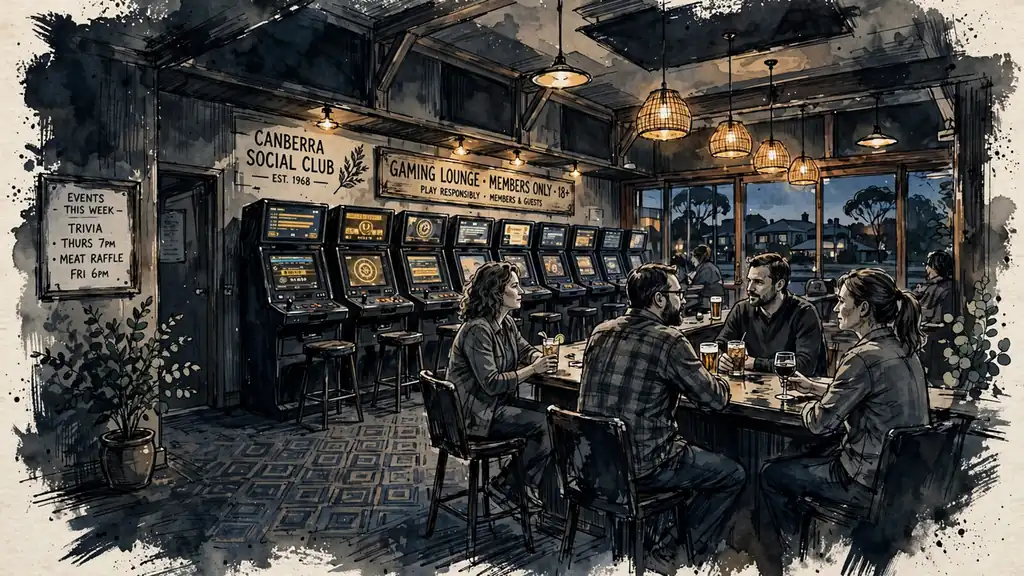
Legality sits beside the timetable, not inside it. Australians may use land-based casinos, licensed bookies and lotteries as legal gambling options. Online casino games, including real-money pokies, are prohibited from being offered to people in Australia. A late physical venue and an offshore website are consequently not two versions of the same service; the hour on the clock cannot turn a prohibited online product into a locally licensed one.
Payment language can create another false impression of continuity. A market summary records that, since 11 June 2024, credit cards, credit-related products and cryptocurrency have been banned as payment methods for online wagering in Australia. That restriction belongs to online wagering payments, not to evidence that a particular land-based gaming room remains open at dawn.
Nor does a closing time say anything about a machine’s behaviour. Each spin is independent. RTP is a long-term theoretical measure, while volatility describes the pattern of payouts, not the hour at which they occur. A machine available at 5am is not luckier, safer or better paying because the building has stayed open.
Availability. Legality. Game design. Three separate questions.
Does playing faster or slower affect results?
No. Each spin is independent, so changing the speed of play does not influence the outcome of the next spin.
How long are self-exclusion periods?
Self-exclusion periods are not specified in the available information.
Are there caps on cashouts or winnings?
Yes. Withdrawal limits commonly range from A$500 to A$2,000 per request, while typical daily and weekly caps are A$5,000–10,000.
Created by the ”Bet Aussie” editorial team.