Best New Australian Online Pokies Explained
 Available in US
Separate release hype from game mechanics, legal limits, payment access and the realities of Australian play.

Table of Contents
- What “New Pokies” Really Means in 2026
- The Australian Legal Line: Why Online Casino Pokies Are Not a Legal Market
- Game Types and Volatility: From Buffalo Power to Dolphin Treasure
- How to Assess a New Pokie Without Mistaking Hype for Evidence
- New PayID Pokies Australia Searches Meet an Uncomfortable Fact
- PayID Login, E-Wallets and the Mechanics of Access
- Megaways, E-Wallets and the Vocabulary of New Releases
- New Pokies Games and Sites: What Can Actually Be Discussed
- Microgaming, Suppliers and the Problem with Brand Assumptions
- What Legal Australian Play Looks Like Offline
- State Rules Put the “Australian” in Australian Pokies
- Machines, Limits and Local Habits Across the Remaining States
- Responsible Play Begins with the Rules, Not the Release Calendar
- Reading “Best New Pokies” Claims Without a False Winner
What “New Pokies” Really Means in 2026
“New pokies” sounds like a promise of novelty, but novelty is not a mathematical advantage. A recently released game may have different artwork, a fresh theme, unusual bonus features, or a new way of displaying its reels. None of that changes the basic fact that each spin is a separate event. The machine does not become more generous because its title has just appeared, and an older pokie does not become less random because players have seen it before.
That distinction matters when phrases such as best new Australian online pokies 2026 are used to describe a category rather than a measurable result. “New” can refer to a release, a newly added title, a redesigned interface, or simply a game that has only recently reached a particular audience. It is a label about timing and presentation. It is not a statistical rating.
A new release still has independent spins
Every spin on an online pokie is independent of the one before it. A win does not make another win less likely, and a run of losses does not create a debt that the machine must repay. The previous result has no bearing on the next outcome.
This is easy to understand in theory and surprisingly difficult to feel in practice. Humans are excellent at finding patterns, including patterns that are not there. A sequence of small wins can look like momentum. Several losses can appear to signal that a feature is “due”. A newly released game can encourage the same interpretation because its unfamiliar sounds and animations make ordinary random variation feel significant.

It is not significant in that sense. The next spin remains an independent event.
The calendar is irrelevant as well. A game released in 2026 does not carry a special first-week quality, just as a long-established pokie does not lose its underlying properties through age. Newness belongs to the product cycle; randomness belongs to the game’s operation.
RTP is a long-run measure, not a session promise
RTP, or Return to Player, is the central figure used to describe a pokie’s long-run statistical behaviour. It is not a forecast of what a particular session will return. A short session can finish substantially above or below the published RTP.
That difference is where much promotional language becomes slippery. A displayed RTP may look precise, even authoritative, but precision does not turn it into a personal guarantee. The figure describes statistical performance across a very large number of spins. It does not state that a particular player, on a particular day, will receive that proportion back.
A new pokie can therefore have a published RTP and still produce a sharply different short-term experience. A session may end with a notable win, a small return, or nothing meaningful at all. The age of the game does not narrow that range. Neither does a player’s belief that a machine has been “cold” or “hot”.
RTP is useful because it provides a long-run reference point. It is misleading when treated as a promise attached to one sitting.
Volatility describes the shape of the ride
RTP does not tell the whole story. Volatility describes how returns tend to be distributed through play.

High-variance pokies pay out less frequently but in larger amounts. Low-variance pokies pay out more frequently but in smaller amounts. These are different playing profiles, not simple grades of quality. One is not automatically better than the other, and neither label predicts the result of the next spin.
This distinction gives the word “best” a rather unstable foundation. A player looking for frequent small returns is describing a different preference from someone willing to accept fewer hits in search of larger ones. Calling a game the best new pokie without stating what “best” means is less analysis than decoration.
Volatility also should not be confused with RTP. Two games can be discussed through both measures, yet volatility concerns the pattern and size of payouts, while RTP concerns the long-run statistical return. A bright theme, a famous character, or an elaborate feature may influence attention. It does not replace either measure.
What audited RNG evidence adds
The Random Number Generator, or RNG, is the mechanism responsible for producing outcomes. It operates independently of time, player traffic, and other external factors. Busy periods do not make a game tighter. Quiet periods do not make it more generous. The hour on the clock has no special relationship with the next result.
For licensed Australian-facing online platforms, RNGs are required to be independently audited. That requirement matters because it concerns the integrity of the outcome-generating system rather than the attractiveness of the game’s packaging. An audit is not a promise of profit, nor does it remove variance. It is evidence that the random-number process has been examined independently under the relevant licensing expectations.
An audited RNG provides evidence that the random-number process has been examined independently, though it does not guarantee specific outcomes or remove variance.
The distinction is worth keeping intact. Fair randomness can still produce losing sessions. An audited RNG does not smooth results into a comfortable pattern, and it does not make a new title mathematically superior to an old one. It supports confidence in the process, not confidence in a particular outcome.
Reading “new” with a cooler head
A sensible description of new online pokies begins with questions that are less glamorous than release dates. What does the RTP represent? What volatility profile is being described? Is the RNG independently audited where the applicable licensing framework requires it? Are claims about freshness being mistaken for claims about advantage?
Those questions separate a product announcement from an assessment. They also explain why a new pokies list cannot, by itself, establish the best new online pokies. A list can show which titles are recent or newly visible. It cannot turn independent spins into a predictable sequence.
The vocabulary of new pokies online is therefore best treated as a description of change in the catalogue, not a shortcut to better odds. New graphics. New mechanics. The same mathematics.
The Australian Legal Line: Why Online Casino Pokies Are Not a Legal Market
The phrase “new online pokies Australia” sounds like a product category. Legally, it is not one. Australia does not have a domestic market in which an online casino may lawfully offer real-money pokies to Australian customers. The central rule comes from the Interactive Gambling Act 2001, which treats online casino games such as pokies as prohibited interactive gambling services when supplied to people in Australia.
That distinction matters because “new” changes the release date, not the legal status. A recently launched pokie remains an online casino game if it is offered for real money through an internet casino. Calling it a new pokie in Australia does not turn a prohibited service into a permitted one. Nor does the use of Australian currency, familiar payment branding, or Australian-themed marketing create a local authorisation that does not exist.

What the Act actually prohibits
The Interactive Gambling Act 2001 is aimed primarily at providers of prohibited online gambling services. Online casinos offering real-money pokies to Australians are banned. The same legal boundary covers other online casino products, including roulette, blackjack, and live dealer tables.
This is not a rule that merely asks operators to display a warning or obtain a foreign licence. No Australian gambling licence exists for casino games offered online to Australian residents. The country does licence other forms of gambling, but that permission does not stretch across every product carrying the word “casino”.
The law also draws an important distinction between the service provider and the individual player. The Act targets the provider rather than making Australians criminals simply for placing bets at offshore sites. That does not make such sites legal, locally regulated, or protected by an Australian casino licence. It means the legal responsibility is structured around the act of supplying the prohibited service.
A neat distinction. Not a loophole.
What remains legal
Australia’s gambling landscape is divided rather than uniformly open or closed. Land-based casinos can operate under the relevant state or territory arrangements. Their machines are physical products in regulated venues, not online casino pokies available through a domestic internet licence.
Licensed bookmakers may offer sports and race wagering under the applicable licensing system. Lotteries are also legal and licensed. These categories sit on a different legal footing from online casino games. A licence to provide wagering does not authorise a bookmaker to add online pokies, just as a lottery licence does not create permission to run an internet casino.
Legal Status Online casino games offering real-money pokies to Australians are prohibited under the Interactive Gambling Act 2001.
The word licensed therefore needs an object attached to it. A licensed bookmaker is not a licensed online pokie provider. A legal lottery is not an online casino. A land-based casino is not evidence that an equivalent internet service is permitted.
This is where descriptions of “best new pokies Australia” can become misleading. They may refer to physical machines in Australian venues, to game concepts discussed in general terms, or to overseas websites that are not authorised to serve Australian customers. Those are different things, and collapsing them into one cheerful category produces a false picture of the market.
Enforcement is part of the boundary
The Australian Communications and Media Authority (ACMA) enforces restrictions on illegal online gambling services. A specialist industry review describes that enforcement as including requests to block shady sites and warnings to influencers involved in dodgy promotions. The practical message is plain: advertising or promoting an offshore online casino to Australian customers is not a harmless way to describe entertainment.
That also explains why a foreign licence cannot be presented as an Australian permission slip. An offshore casino may hold authority from another jurisdiction, but that does not make it lawful to offer real-money pokies to Australians. Australia’s prohibition is concerned with the service reaching its local customer base.
Consequently, “new online pokies real money” is not a legal Australian product label. It describes a prohibited online casino service when the intended customer is in Australia. The same applies to claims about new pokies in Australia if those claims suggest that a domestic online casino market is available.
The legal line is therefore less glamorous than a release calendar, but considerably more useful. New software may exist. New themes may exist. A legal Australian online casino for real-money pokies does not.

Game Types and Volatility: From Buffalo Power to Dolphin Treasure
The word “new” tells very little about how a pokie feels to play. Volatility tells more. It describes the pattern of returns: whether wins tend to arrive less often in larger bursts, or more frequently in smaller amounts. That distinction is more useful than a ranking dressed up as certainty. A new release is not automatically gentler, more generous, or more entertaining than an older game.
High-variance pokies create a stop-start rhythm. Long stretches may pass without a notable hit, followed by a larger result that changes the tone of the session. Low-variance pokies tend towards a busier pattern, with smaller returns appearing more steadily. Neither profile changes the mathematics of independent spins. It changes only the shape of the possible ride.
Buffalo Power: the high-variance profile
Buffalo Power by Playson is described as a high-variance pokie in a specialist review, with infrequent but larger hit patterns. That description places the game at the more dramatic end of the volatility spectrum. It does not mean that a larger result is due, nor that a quiet sequence is building towards one. The next spin remains separate from every spin before it.
This is where the language of “power” can quietly do too much work. A strong theme, expanding symbols, or a conspicuous bonus presentation may suggest momentum, but presentation is not probability. A game can look energetic while producing a long run of modest or unsuccessful outcomes. It can also produce a notable result without any ritual, timing choice, or preferred hour having caused it.
High-variance profile with infrequent but larger hit patterns.
Lower-variance profile with steadier, smaller returns across a session.
For a high-variance game, the important question is not whether a player likes large wins in the abstract. It is whether the player understands that those wins may be separated by fewer, smaller, or absent returns. A session can feel uneventful for a considerable stretch. That is not evidence of a machine “warming up”; it is the ordinary possibility built into the variance profile.
The same point applies to claims about a game being “hot” after a visible win. The previous result has no bearing on the next outcome. A large Buffalo Power hit does not make another large hit more likely, and a sequence of losing spins does not make one more necessary. Chance has no memory, despite the persistent human wish to give it one.
Dolphin Treasure: a steadier pattern
Dolphin Treasure by Aristocrat is described as a lower-variance pokie in a specialist review, with steadier smaller returns across a session. Its profile therefore contrasts with the pattern attributed to Buffalo Power. More frequent smaller returns can make a game feel less abrupt, but they do not turn it into a predictable source of profit. “Steadier” describes the distribution of results, not a promise that every session will contain a return.
This distinction matters because players often confuse activity with value. A screen that produces regular minor wins may feel reassuring, even when those wins do not outweigh the stakes placed. Conversely, a quiet game may feel defective when it is simply displaying the less frequent hit pattern associated with higher variance. The emotional reading of a session is not a statistical report.

Dolphin Treasure also demonstrates why the label “best new pokies” is too blunt to settle anything. A player seeking a lively sequence of smaller outcomes may prefer the lower-variance description. Another may find that pattern dull and prefer the tension of a higher-variance game. Preference is real, but it is not evidence that one title has superior mathematics.
Volatility is not RTP
Volatility and RTP answer different questions. Volatility describes how returns are distributed over play: frequent and smaller, or less frequent and larger. RTP is a long-run statistical figure. It does not predict what happens during a short session, which can finish substantially above or below the published percentage.
A game with a lower-variance profile is therefore not automatically a better-value game. Nor is a high-variance game automatically worse. Without inventing a ranking, the sensible comparison is structural: how often the game is described as returning, how large those returns may be when they arrive, and how easily a short session can depart from the long-run expectation.
The distinction also travels across the vocabulary surrounding Australian and New Zealand-themed searches. Phrases about New Zealand pokies, online pokies associated with New Zealand, or newer PayID-labelled games may group together location, payment language, release timing, and game style. Those are different categories. A payment label says nothing about volatility. A regional theme says nothing about RTP. A recent release date says nothing about the next spin.
Reading the playing profile plainly
A useful comparison can be kept compact:
| Game | Provider | Profile described in the available source |
|---|---|---|
| Buffalo Power | Playson | High variance, with infrequent but larger hit patterns |
| Dolphin Treasure | Aristocrat | Lower variance, with steadier smaller returns across a session |
The table is not a league table. It does not identify a winner, and it cannot forecast a session. It simply separates two playing profiles that are often flattened into promotional language.
That separation leaves room for the human part of gambling: anticipation, disappointment, boredom, and the peculiar optimism produced by a near miss. Those reactions may explain why different volatility profiles appeal to different people. They do not alter the random outcome. New branding may change the scenery. Variance changes the rhythm. Neither changes the fact that every spin stands alone.
How to Assess a New Pokie Without Mistaking Hype for Evidence
A new release can arrive wrapped in bright graphics, dramatic sound effects and language suggesting that its moment has come. None of that changes what the available evidence can actually show. The useful reading begins with separating a game’s design information from the story told around it.
Assessment Questions
What RTP Can—and Cannot—Tell
RTP, or Return to Player, is a long-run statistical figure. It describes how a game is expected to behave across a very large number of spins, not what a particular short session will produce. A published RTP therefore cannot promise that a session will return the stated proportion, or anything close to it. Short sessions can finish substantially above or below that figure.
That distinction matters when comparing new release pokies. RTP may be relevant when the figure is available from a reliable source, but it is not a forecast for an evening, a chosen stake or a lucky-looking sequence. It is a measure of statistical tendency over time. The decimal is not a prophecy.
Why Previous Results Do Not Help
Each spin is independent. A win does not make another win more likely, and a run of losses does not make a payout “due”. The previous result has no bearing on the next outcome. Patterns noticed in a recent sequence may be psychologically persuasive, but they do not become evidence merely because they are easy to remember.
The same applies to rituals built around timing. An RNG does not respond to the hour, the amount of traffic on a platform or the moment at which a spin is started. Waiting for a quieter period, changing the pace or repeating a personal routine cannot alter the underlying result. Hype supplies a narrative; the mathematics remains indifferent.
New PayID Pokies Australia Searches Meet an Uncomfortable Fact
PayID sounds distinctly Australian: familiar banking infrastructure, a local name, and the promise of money moving without the ceremonial fuss of older payment methods. That familiarity can make searches for new PayID pokies feel like a search for a domestic product. It is not.
PayID is a payment method. It is not a gambling licence, a regulator, or a legal permission slip. A transfer can be technically available while the service receiving it remains prohibited. The plumbing does not rewrite the law.
Payment Methods Attention: Using PayID or e-wallets does not change the legal status of a service or grant an Australian gambling licence.
Under the Interactive Gambling Act 2001, online casinos offering real-money pokies to Australians are banned. That applies whether the page presents itself as a new release hub, a mobile casino, a PayID destination, or an apparently polished Australian-facing service. The method used to move money changes the transaction, not the status of the gambling product.
Why “no deposit” changes nothing
The phrase “no-deposit bonus” carries its own small theatre. It suggests that the first encounter involves no financial risk because no initial payment is required. Yet a promotion is still part of the service being offered. It may be designed to attract registration, encourage later deposits, or keep a person playing after the free amount has disappeared. Free at the entrance does not mean legally permitted at the door.
A no-deposit offer cannot make online pokies lawful in Australia. Nor can it create a local authorisation where no Australian real-money online casino licence exists. The same point applies to phrases such as:
- new online pokies with a no-deposit bonus;
- new PayID pokies with a free offer;
- Australian pokies with instant account funding;
- a “best” new PayID casino selected because it advertises a welcome incentive.
These are descriptions of marketing language, not evidence of legality. A bonus is not a licence. PayID is not a licence. A fresh game is not a licence.
That distinction matters because inducements are not innocent decoration. Promotions encouraging people to open an account or begin gambling sit close to the activity regulators scrutinise. The Australian Communications and Media Authority, referred to as ACMA, enforces restrictions in this area. A profile-style industry review describes ACMA as blocking shady sites and warning influencers about dodgy promotions. The warning is less glamorous than the advertisement, which is precisely its point.
The Australian label is not a legal category
“Made for Australians” can mean that a page uses Australian spelling, displays Australian dollars, mentions PayID, or arranges its copy around local habits. None of those features establishes Australian authorisation. They establish targeting.
The word “Australia” in a title is therefore doing commercial work, not regulatory work. A service can be Australian-facing without being Australian-licensed. It can accept a familiar payment route without being entitled to provide online casino pokies. It can show a login button without possessing any lawful right to offer the underlying game.
This is where the idea of “best new PayID pokies Australia” becomes unstable. Best by what measure? A recent theme? A payment interface? A promotional headline? None answers the prior question: may the service legally provide real-money online pokies to Australians? If the answer is no, ranking its convenience risks turning a prohibited product into a recommendation by another name.

The same caution applies to e-wallet language. An e-wallet may sound more separate from a bank account, but separation of payment instruments does not separate the transaction from the gambling law. A wallet, PayID transfer, card, or other funding route cannot convert prohibited online casino play into a licensed Australian product.
Promotion is not neutral information
There is a difference between explaining that a promotion exists and encouraging people to claim it. The first can be necessary when describing how gambling advertising works. The second may become an inducement.
That boundary rules out the usual promotional vocabulary: “claim now”, “join for free”, “boost the first session”, or “use PayID for a faster start”. It also rules out operator lists, referral links, bonus codes, and instructions for opening or funding accounts. Such material would not merely describe a market; it would help supply a prohibited service to Australians.
The more polished the offer, the easier it is to mistake marketing for reassurance. A clean interface, Australian currency, a recognisable payment brand, and a fresh catalogue can create the atmosphere of legitimacy without supplying its substance. Casinos have always understood the value of atmosphere. Online, the atmosphere arrives before the authority.
What PayID can and cannot tell anyone
PayID can indicate how a payment is routed. It cannot establish:
- that the recipient is authorised to provide online pokies in Australia;
- that the games are covered by an Australian casino licence;
- that a promotional offer is lawful;
- that an Australian regulator approves the service;
- that a new game is safe, fair, or legally available.
Those questions belong to regulation and evidence, not to the payment screen. In Australia, no domestically licensed real-money online casino exists for Australian players. That makes the distinction unusually sharp: local-looking payment access should not be read as local gambling authorisation.
A search for new PayID pokies may therefore reveal a mismatch between consumer language and legal reality. The language speaks of novelty, convenience, and bonuses. The law speaks of prohibited interactive gambling services. Between them sits a payment method, doing its limited job.
That job should not be asked to carry more meaning than it can bear.
PayID Login, E-Wallets and the Mechanics of Access
Login language often makes a gambling service sound more established than it is. A page may mention a new PayID login, an e-wallet wallet, or a quick account area, as though the existence of a sign-in screen settles the important question. It does not. Access is a technical function. Authorisation is a legal one.
Technical Access A login provides technical access to an account, displaying balances or settings, but it does not grant legal authorisation for the service to operate in Australia.
That distinction matters in Australia because online casinos offering real-money pokies to Australians are banned under the Interactive Gambling Act 2001. A username, password, payment button, or customer dashboard cannot alter that position. Nor can the presence of a familiar financial brand make an online pokie service locally authorised. The door may open. The room may still be unlawful.
What a login actually does
A login normally connects an account holder with stored account information. It may display a balance, transaction history, identity checks, game preferences, or responsible-play settings. An e-wallet login performs a related but separate task: it authenticates access to the wallet itself, not to the legal gambling market in which a payment might later be used.
PayID sits in a different part of the chain again. It is a payment method associated with Australia’s banking infrastructure, while a login is an access credential. One identifies or confirms an account; the other moves a person into an account area. Treating them as interchangeable produces the kind of tidy technical confusion that financial language enjoys. Conveniently tidy. Still confusion.
A payment method does not licence the product being paid for. An e-wallet does not become a gambling regulator by appearing beside a deposit field. The same principle applies to a familiar bank-transfer label: its presence says something about payment routing, not about whether the recipient may lawfully provide online pokies to Australians.
Why “new” changes very little
A newly designed account page can change the appearance of a service without changing its legal character. The same is true of a fresh wallet integration or a revised sign-in process. New software is not a new licence. A polished interface may reduce friction, but friction is not the test imposed by the Interactive Gambling Act.

This is particularly relevant when account language suggests that the service is local. Australian spelling, Australian currency, PayID references, and customer-support wording can create a sense of domestic presence. None of those details establishes an Australian authorisation for online casino games. They describe presentation or payment compatibility, not permission to offer real-money pokies.
The question therefore has to be separated into two parts. First: what does the login allow an account holder to do technically? Second: may the underlying service legally offer online pokies to an Australian customer? The first answer cannot supply the second.
The practical boundary
Searches for new e-wallet pokies login or a new PayID pokies login often express a wish for continuity: one set of credentials, one familiar payment route, fewer interruptions. That is understandable as a description of digital behaviour. It is not a reason to treat prohibited online casino access as an approved Australian service.
Nor should an account screen be mistaken for evidence of protection. A login may organise transactions, but it does not by itself demonstrate that the service is covered by Australian gambling safeguards. It does not turn an offshore operation into a domestic casino, and it does not create a local licence where none exists.
For Australian readers, the mechanics are therefore the smaller story. A login authenticates. A wallet stores or transfers funds. PayID identifies a payment path. None of them authorises online pokies. The legal line remains exactly where it was before the password was entered.
Essential Distinction Megaways refers to a game design format, while e-wallets refer to a financial mechanism; neither indicates legal status or mathematical advantage.
Megaways, E-Wallets and the Vocabulary of New Releases
“Megaways” and “e-wallet” often appear beside each other in descriptions of new pokies, but they belong to entirely different vocabularies. One describes how a game may construct its winning combinations. The other describes a payment tool. Confusing them is a small linguistic error with rather larger consequences: a banking label cannot tell anyone whether a pokie is legal, fair, or suitable.
Megaways Is a Game Format
Megaways is a format label attached to certain pokie designs. It signals a changing-reel or variable-ways structure rather than a particular payment method, licence, or guarantee of returns. A new Megaways release may therefore look more mechanically elaborate than a conventional pokie, yet the label alone says nothing about its RTP or volatility.
That distinction matters because visual activity can be mistaken for mathematical generosity. More symbols, shifting reel arrangements, and animated features may create a busier experience; they do not turn independent spins into a pattern that can be predicted. Nor does a fresh release acquire better odds merely by carrying a fashionable format name.
Volatility remains the more useful question. High-variance pokies pay less frequently but in larger amounts, while low-variance pokies pay more frequently but in smaller amounts. Megaways does not settle that question by itself. It is a design family, not a risk classification.
E-Wallets Belong to Banking
An e-wallet is a payment label. It concerns how money may be held or transferred, not how a pokie calculates an outcome. That is why descriptions of “new e-wallet pokies” are mixing two separate subjects: the game on one side and the transaction channel on the other.
The separation is especially important in Australia. Payment convenience does not create a domestic online casino licence, and an e-wallet cannot make prohibited online casino play lawful. A polished checkout is still only a checkout. It is not regulatory permission dressed in a modern interface.
These labels can also encourage a peculiar kind of optimism. “New” suggests discovery, “Megaways” suggests spectacle, and “e-wallet” suggests frictionless access. None of the three establishes an advantage over the house, a particular RTP, or protection equivalent to regulated local gambling. Attractive vocabulary remains vocabulary.
The sensible reading is therefore narrow: Megaways identifies a game format; an e-wallet identifies a financial mechanism. Neither is an endorsement, and neither converts an online casino product into a legal Australian offering. Different labels. Different questions. Same need for scepticism.
New Pokies Games and Sites: What Can Actually Be Discussed
The phrase “new pokies games” can describe a game concept, a theme, a feature set, or simply a title that has recently appeared in a catalogue. That is an editorial subject. It does not, by itself, establish that the game can legally be played online by Australians.
A responsible description can discuss how a pokie is designed: its symbols, bonus structure, reel layout, or the atmosphere built around a theme. It can also identify a named title where the information is relevant, without turning that mention into an invitation to gamble. The line is crossed when description becomes a sales pitch.
That distinction matters because online casinos offering real-money pokies to Australians are banned under the Interactive Gambling Act 2001. A new title may exist as software, yet no Australian-facing online casino is authorised to offer it as a real-money service. Fresh packaging does not alter the legal category.
- Discuss game design and themes.
- Identify technical specifications.
- Describe the legal landscape.
- Use sign-up language or links.
- Offer inducements or bonuses.
- Suggest a service is locally authorised.
A game is not a site
Claims about “new pokies sites” require a different kind of scrutiny. A site is not merely a container for games. It is a service making an offer, collecting accounts and presenting gambling to customers. Publishing its name beside sign-up language, promotional claims, links or inducements would move beyond reporting and towards promotion of a prohibited service.
That is especially relevant when a site borrows the language of local legitimacy. Australian branding, Australian currency, or a payment logo does not create an Australian casino licence. Nor does a foreign licence authorise online casino play for Australian residents.
The Australian Communications and Media Authority, or ACMA, enforces restrictions on illegal gambling services. A profile of enforcement activity reports that it blocks shady sites and warns influencers about dodgy promotions. The practical editorial rule is plain: describe the legal position and the game concept, but do not help a prohibited operator find customers.
The difference can be stated without ceremony.
Conceptual coverage is not commercial endorsement.
A new pokie can therefore be discussed as a piece of game design, while a new pokie site must be treated as a regulatory and publishing question. That separation keeps the subject informative without disguising access to an unlawful online casino as consumer choice.
Microgaming, Suppliers and the Problem with Brand Assumptions
“New Microgaming pokies” sounds precise, but the label carries less information than it appears to. Microgaming is a game provider, not an Australian gambling licence, a regulator, or a guarantee that a particular title is newly released. A supplier name identifies part of a product’s origin; it does not establish where that product may lawfully be offered.
That distinction matters because brand language often borrows authority from familiarity. A recognised provider can make a page look established, while the legal position remains unchanged. Under the Interactive Gambling Act 2001, online casinos offering real-money pokies to Australians are banned. The presence of a well-known supplier does not create an exception.
Nor does the word “new” do much work by itself. It may refer to a recent title, a fresh appearance on a particular platform, a redesigned interface, or merely a page that has been updated. Without a verifiable release detail, calling a Microgaming pokie new is a marketing description rather than a measurable fact. A supplier catalogue should therefore be read as a record of game branding, not as proof of current availability in Australia.
The same caution applies beyond Microgaming. Aristocrat, NetEnt, Play’n GO and Pragmatic Play are names associated with game production, but none of those names authorises online casino play for Australian residents. Product identity and legal availability belong to different columns.
That separation is less glamorous than a launch announcement. It is also the part that survives the announcement.
What Legal Australian Play Looks Like Offline
State Rules Put the “Australian” in Australian Pokies
Machines, Limits and Local Habits Across the Remaining States
A profile review reports that New South Wales has 100,500 gaming machines: 99,000 in clubs and hotels, and 1,500 at Star Casino in Sydney. In clubs and hotels, the maximum bet is $10 per spin. Reported win limits are $10,000, or $500,000 when linked across venues.
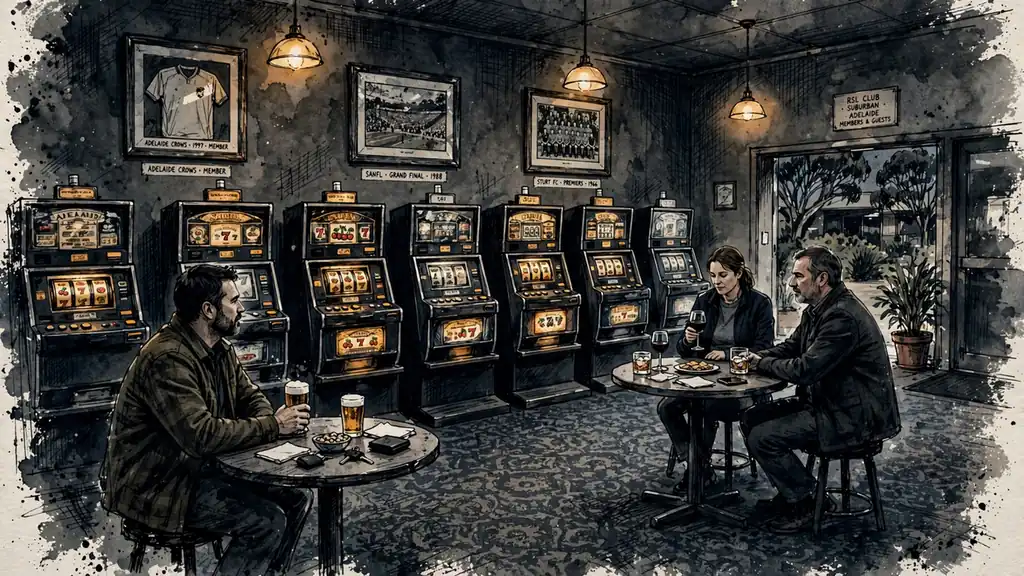
South Australia presents a more tactile arrangement. A profile review reports 13,113 gaming machines: 12,118 in clubs and hotels, and 995 at Adelaide Casino. The machines accept coins only because note acceptors are banned. The reported minimum spin rate is 3.5 seconds, with a $10 maximum bet per spin and an 87.5% minimum RTP.
Tasmania has 3,680 gaming machines across hotels, clubs, and two casinos: Wrest Point and Country Club, according to a profile review. Tasmanian machines have a minimum spin rate of three seconds, a $5 maximum bet per spin, and a maximum of 30 lines.
Victoria’s reported total is 30,000 gaming machines, including 27,500 in clubs and hotels and 2,500 at Crown Melbourne. A profile review states that clubs and hotels impose a $5 maximum bet and an 87% minimum RTP, while casinos have no maximum bet.
The contrast is less about a national playing style than about local administration. A machine in South Australia is shaped by a ban on note acceptors; a Tasmanian machine by a line limit; a Victorian machine by separate club, hotel, and casino rules. The word “Australian” hides a federation of habits.
Responsible Play Begins with the Rules, Not the Release Calendar
Reading “Best New Pokies” Claims Without a False Winner
This page brings together new Australian online pokies options for 2026, with key licensing, bonus, deposit and payment details to help readers make a more informed shortlist. Use the information below as a starting point for checking which offers and conditions fit your preferences.
License: Curacao eGaming Licence · Min. deposit: A$10 WinSpirit is listed with a Curacao eGaming Licence and a minimum deposit of A$10. It may suit players looking for a low starting deposit.
License: Curacao eGaming Licence · Min. deposit: A$10 PlayCroco operates under a Curacao eGaming Licence and lists a minimum deposit of A$10. Its main stated feature is the low entry requirement.
License: Curacao · Bonus: up to A$2,000 Golden Pokies is licensed in Curacao and advertises a bonus of up to A$2,000. The bonus is the key listed reason to consider this operator.
License: Curacao (operating since 2017) · Bonus: 250% up to A$2,000 + 50 free spins on the first of six deposits · Min. deposit: A$20 Uptown Pokies has operated under a Curacao licence since 2017. Its welcome offer is 250% up to A$2,000 plus 50 free spins on the first of six deposits, with a minimum deposit of A$20.
License: Curacao eGaming (Hollycorn N.V., since 2017) · Bonus: 225% up to A$1,540 + 600 free spins across 4 deposits, 20x wagering · Min. deposit: A$20-30 (depends on the offer) Playfina Casino operates under Curacao eGaming through Hollycorn N.V. and has done so since 2017. It lists 225% up to A$1,540 plus 600 free spins across four deposits, with 20x wagering and a minimum deposit of A$20–30 depending on the offer.
License: Curacao Gaming Control Board OGL/2023/176/0095 (Hollycorn N.V.) · Bonus: up to A$5,000 + 300 free spins across 4 deposits Rollero Casino holds Curacao Gaming Control Board licence OGL/2023/176/0095 through Hollycorn N.V. Its listed promotion offers up to A$5,000 plus 300 free spins across four deposits.
License: Curacao Gaming Control Board OGL/2023/174/0082 (Dama N.V.) · Bonus: up to A$5,000 + 300 free spins across 4 deposits SpinsUp is licensed by the Curacao Gaming Control Board under OGL/2023/174/0082 through Dama N.V. Its headline offer is up to A$5,000 plus 300 free spins across four deposits.
License: international iGaming licence – jurisdiction not named in the source · Bonus: 100% up to A$1,000 + 100 free spins, 35x wagering · Payout speed: PayID 1-24 hours · Min. deposit: A$30 (PayID from A$10) House of Pokies lists an international iGaming licence, although the source does not name the jurisdiction. It offers 100% up to A$1,000 plus 100 free spins, 35x wagering, PayID payouts in 1–24 hours, and a minimum deposit of A$30, or A$10 with PayID.
License: Curacao – Antillephone N.V. (Versus Odds B.V.) · Bonus: up to EUR 2,000 across 5 deposits + 200 free spins · Min. deposit: EUR 20 Thor Casino is licensed in Curacao by Antillephone N.V. through Versus Odds B.V. Its offer provides up to EUR 2,000 across five deposits plus 200 free spins, with a minimum deposit of EUR 20.
License: Curacao · Bonus: up to A$10,000 multi-stage + 500 free spins · Min. deposit: A$20 (POLi) Lucky Dreams operates under a Curacao licence and advertises a multi-stage bonus of up to A$10,000 plus 500 free spins. The listed minimum deposit is A$20 when using POLi.
Created by the ”Bet Aussie” editorial team.