
Bitcoin Pokies Australia: Legal Reality and Key Facts
 Available in US
Separate cryptocurrency payment claims from the game itself and assess online pokies through the rules surrounding them.

Table of Contents
- What Bitcoin Pokies Mean in Australia in 2026
- Bitcoin Online Pokies: The Legal Reality Behind the Label
- How to Assess the Best Online Pokies Without Chasing a Myth
- The Best Bitcoin Pokies in Australia Are Defined by the Rules Around Them
- Best Bitcoin Pokies Sites: What Can Actually Be Legal in Australia
What Bitcoin Pokies Mean in Australia in 2026
The phrase “bitcoin pokies” sounds more precise than it is. In Australian gambling language, it can describe pokie-style games associated with cryptocurrency payments, websites that use Bitcoin in their branding, or a general promise of playing online with digital money. Those are different things placed under one shiny label.
For Australian readers in 2026, the important distinction is between the game and the payment language surrounding it. A pokie remains a digital reel game, with symbols, winning combinations, bonus features and a mathematical model. Bitcoin does not turn it into a separate class of machine. It changes, or claims to change, the way money is moved around the service. The reels do not become more transparent because the deposit is made in cryptocurrency. Nor does a blockchain replace the game’s internal random number generator.
That matters because cryptocurrency branding often borrows the authority of technology. A coin logo, a wallet reference and a promise of fast transactions can make an old gambling proposition look newly engineered. The underlying question is less glamorous: who is allowed to offer the game, and under which rules?

What the word “pokies” means here
In Australia, pokiesis the ordinary local term for slot-style gambling machines and their online equivalents. It is not a technical description of a particular payment method. Adding “bitcoin” creates a commercial category rather than a new type of mathematics.
An online pokie still produces outcomes through a Random Number Generator, or RNG. The RNG operates independently of the time of day, the number of players using a service and other external factors. A busy room, a quiet website or a rising Bitcoin price does not instruct the next spin to behave differently. The machine has no sense of occasion.
Each spin is independent. The previous result has no bearing on the next outcome. A run of losing spins does not make a win “due”, and a recent win does not make the next result less likely merely because the machine appears to have paid. This is one of the oldest misunderstandings in gambling, dressed in modern vocabulary.
The same principle applies whether a person thinks in Australian dollars or in cryptocurrency units. The denomination may change the appearance of the transaction, but it does not create a memory inside the game. There is no reliable pattern to extract from the last sequence of symbols.

Bitcoin is not a fairness certificate
The appeal of Bitcoin-related gambling language usually rests on several ideas: digital payments, fewer traditional banking steps, international availability and the impression that technology might make the transaction more private or efficient. None of those ideas proves that a pokie is fair, legal or suitable for Australian residents.
A cryptocurrency payment is also not the same as a transparent game. The payment rail and the outcome-generating system are separate parts of the arrangement. A public blockchain may record a transfer, but it does not automatically reveal how the pokie’s RNG was designed, tested or audited. Nor does a wallet address identify the legal status of the operator offering the game.
This separation is useful when reading claims about “provably fair” play. Even if a service presents technical material about hashes or seeds, that material should not be confused with Australian authorisation. Technical language can explain a mechanism. It cannot create a local gambling licence where the law does not provide one.
The Australian position is therefore not softened by the fact that Bitcoin is a recognised digital asset or that cryptocurrency services operate in other parts of the economy. A lawful payment instrument in one context does not authorise every product purchased with it. A bank transfer does not make a prohibited casino legal; neither does Bitcoin.
RTP describes the long run, not the afternoon
Another term that belongs in any serious discussion of pokies is RTP, meaning Return to Player. RTP is a long-run statistical figure. It describes the proportion a game is designed to return over a very large number of spins, not the result promised by a short session.
A brief run can finish substantially above or below the published RTP. That remains true when the account is funded with cryptocurrency. Bitcoin does not shorten the distance between probability and personal fortune.
Variance adds another layer. High-variance pokies tend to produce less frequent wins that can be larger, while low-variance pokies tend to produce more frequent wins that are smaller. These are descriptions of the rhythm of results, not guarantees about what will happen during a particular visit. A player who prefers frequent small outcomes is responding to a different pattern from someone willing to tolerate longer dry spells for the possibility of a larger hit.
High variance with infrequent but larger hit patterns.
Lower variance with steadier smaller returns.
Two labels are worth treating cautiously because they come from individual commentary rather than a universal market classification. A specialist review describes Buffalo Power by Playson as high variance, with infrequent but larger hit patterns. A specialist review describes Dolphin Treasure by Aristocrat as lower variance, with steadier smaller returns across a session. Those descriptions may help explain how variance is discussed, but they should not be inflated into an official rule covering every machine or every configuration.
The point is not that one variance profile is morally superior. It is that the vocabulary can be used to make a session sound more predictable than it is. The mathematics remains indifferent to the story told around it.
The Australian legal boundary
For Australians, the decisive fact is the Interactive Gambling Act 2001. Online casinos offering real-money pokies to Australians are banned. That prohibition covers the service offered to the customer, not merely the currency used to fund an account. Calling the product a Bitcoin casino, a crypto pokie room or a blockchain gaming platform does not move it outside the rule.

There is no Australian licence for a casino product that may lawfully offer real-money online pokies to Australian residents. This is why foreign branding and overseas payment options should not be mistaken for local approval. A service may describe itself as international, decentralised or crypto-native; those descriptions do not establish permission to provide online casino games in Australia.
The enforcement picture also matters. Based on a specialist industry overview, ACMA enforces restrictions by blocking shady sites and warning influencers against dodgy promotions. The practical lesson is plain: a website being visible, discussed or promoted does not mean it is authorised for Australian customers. Visibility is not legality. Advertising is not accreditation.
The law targets providers rather than making the individual player a criminal for placing a bet at an offshore site. That distinction should not be turned into an endorsement. A customer may not be the primary target of the prohibition, while still facing the ordinary risks of dealing with an offshore service: uncertain access, weak recourse, disputed transactions and changing availability. The absence of a criminal penalty for the player is not a consumer guarantee.
What remains available
The legal gambling landscape is not empty. Land-based casinos, licensed bookmakers and lotteries are legal options for Australians to engage in gambling, subject to the rules that apply to each product and jurisdiction. The distinction is important because online casino pokies and licensed wagering are not interchangeable categories.

A licensed bookmaker is not an online pokie operator. A lottery is not a crypto casino. A land-based venue is not made into an online service because its machines accept a modern payment method. The country has chosen to regulate gambling through a patchwork of state, territory and federal arrangements rather than through one neat national doorway. It is untidy, but it is the structure that exists.
That structure also explains why “bitcoin pokies Australia” should be read as a description of a market conversation, not as proof that a lawful domestic product exists. The phrase gathers together a familiar Australian gambling form and a digital currency association. It does not answer the questions that matter most: what is being offered, where is it offered, and is that offer permitted for Australian residents?
The technology may change its costume. The rules do not change with the costume.
Bitcoin Online Pokies: The Legal Reality Behind the Label
The phrase “bitcoin online pokies” sounds more settled than it is. It can describe pokies displayed on a website that accepts cryptocurrency, a casino promoting Bitcoin payments, or simply an old-fashioned online slot dressed in digital-currency language. The label changes the payment story, not the legal character of the game.
For Australians, that distinction matters. An online pokie played for real money remains an online casino game whether the deposit is made with Australian dollars, Bitcoin, or another digital asset. Currency does not provide a legal side door. A wallet is still a wallet; a prohibited service does not become permissible because the payment method has a technical vocabulary.
What the Bitcoin label changes — and what it does not
Bitcoin is a payment technology and a form of digital currency. It is not an Australian gambling licence, a regulator, or a special class of gambling product. A website may place a Bitcoin symbol beside its cashier, but that symbol says nothing by itself about whether the operator is permitted to offer pokies to people in Australia.
The same applies to descriptions such as “crypto pokies”, “Bitcoin slots”, or “online pokies with Bitcoin”. These phrases often combine two separate questions:
- how an account is funded;
- whether the underlying gambling service may legally be supplied to an Australian customer.
Only the second question determines the legal position. The payment rail may be novel. The pokie is not.
Under the Interactive Gambling Act 2001, online casinos offering real-money pokies to Australians are banned. That prohibition covers the service being offered, rather than merely the denomination used for a wager. A real-money game does not become a permitted activity because its balance is shown in Bitcoin instead of dollars.
This is an awkward feature of digital advertising: a new financial wrapper can make an old product appear newly legitimate. It cannot make an unlawful online casino local, regulated, or approved.
Australia has no local online casino licence for pokies
Australia regulates gambling through federal and state or territory arrangements rather than through one universal gambling authority. The important point for online pokies is straightforward: no Australian gambling licence exists for casino games offered online to Australian residents.
Local gambling licences do exist for other products. Land-based casinos, licensed bookmakers, and lotteries are legal avenues for gambling in Australia, subject to the rules that apply to each product and jurisdiction. Online sports betting is a different category from online casino games. A licence relevant to wagering does not authorise an operator to provide online pokies.
That boundary is often blurred in promotional language. A business may be known for a legal wagering product while a separate website, brand, or affiliate page discusses casino games. The existence of one lawful gambling service does not create permission for another. Nor does registration in a foreign jurisdiction authorise an operator to serve Australian customers with prohibited online casino games.
There is therefore no Australian-facing local licence that makes Bitcoin pokies legal online. The absence is not a gap for clever branding to fill.
Offshore websites and foreign licences
Many offshore casino websites describe themselves as licensed in places outside Australia. A foreign licence may regulate the operator under the rules of that jurisdiction, but it is not an Australian casino licence and does not override the Interactive Gambling Act 2001.
Prohibited Service Online casinos offering real-money pokies to Australians are banned under the Interactive Gambling Act 2001.
That distinction is essential when a website displays a badge, a licence number, or a reference to external certification. Such material may explain how the operator presents itself elsewhere. It does not establish that the operator is authorised to provide real-money pokies to Australians.
The practical risks are broader than the legality of the game. An offshore website may use cryptocurrency because digital transfers can be difficult to reverse and may sit outside familiar Australian banking processes. That does not make every transaction unlawful for the player, but it can leave fewer local avenues when an account is closed, a balance is disputed, or terms are changed. Technical independence is not consumer protection.
The Australian rules target providers of prohibited interactive gambling services rather than making the Australian player the primary criminal subject. That should not be misread as approval. “Not the main target” is a poor substitute for “legal and protected”.
ACMA’s role in the online boundary
The Australian Communications and Media Authority, known as ACMA, enforces restrictions on illegal online gambling services. Its work includes seeking the blocking of unlawful offshore gambling websites and addressing dodgy promotions, including warnings directed at influencers.
A promotional post can make an offshore casino look ordinary: a familiar game, a payment icon, a cheerful claim about instant access. The legal position remains unchanged beneath the graphics. Promotion is not proof of authorisation, and visibility is not a licence.
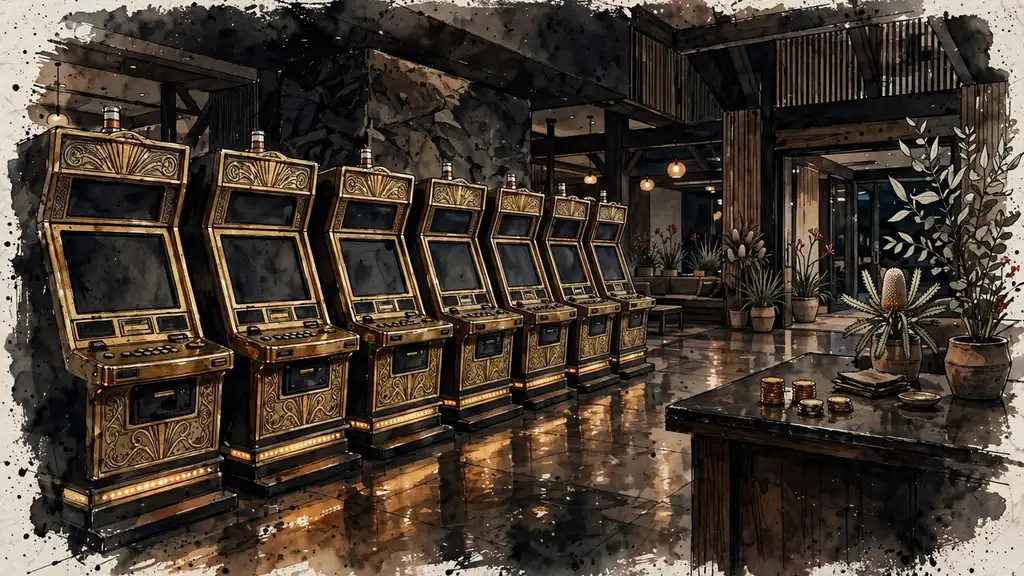
This matters particularly with cryptocurrency advertising. Bitcoin imagery can suggest speed, privacy, or modernity while leaving the central legal question untouched. A social-media recommendation, comparison page, or influencer endorsement cannot turn prohibited online pokies into a lawful Australian service. Nor should a foreign licence be presented as if it were approval from ACMA.
Demo play is not real-money access
Demo spins occupy a different legal and practical space from real-money play. Players can use demo versions to become familiar with a machine before staking money. A demo may show the symbols, bonus features, and general rhythm of a game without creating a real-money gambling account.
That separation is useful, but it has limits. A demo version does not validate the website’s cashier, licence claims, payment options, or legal status. It also does not convert a prohibited real-money service into a permitted one when the balance is later funded with Bitcoin.
The distinction can be expressed plainly:
| Activity | What it establishes |
|---|---|
| Trying a demo pokie | Familiarity with the machine’s presentation and features |
| Funding an online casino account with Bitcoin | A payment choice, not Australian authorisation |
| Playing real-money online pokies from Australia | A service prohibited under the Interactive Gambling Act 2001 |
| Gambling at a legal land-based venue | A different channel governed by applicable local rules |
A demo can show how a game behaves on screen. It cannot show that an operator has a right to offer real-money pokies in Australia.
Why payment language should not lead the decision
Bitcoin-first marketing encourages attention to deposits, withdrawals, wallet compatibility, and transaction speed. Those details may dominate the page because they are easy to advertise. The legality of the underlying service is less decorative and more decisive.
For Australian readers, the order should be reversed. First establish whether the product is an online casino game offered for real money. If it is, the Interactive Gambling Act 2001 places it on the prohibited side of the boundary. Only after that distinction does the payment method become relevant—and in this context, it cannot repair the legal problem.
The lawful alternatives are not hidden inside a cryptocurrency label. They are separate gambling channels: land-based casinos, licensed bookmakers, and lotteries. Online pokies paid for with Bitcoin belong to the category of prohibited online casino services, regardless of how polished the website looks or how familiar the game may seem.
A new coin does not make an old prohibition disappear.
How to Assess the Best Online Pokies Without Chasing a Myth
Comparing online pokies is less like choosing a favourite film and more like reading a machine’s technical label. The name may be memorable, the artwork may be loud, and the theme may promise treasure, adventure or some other form of instant redemption. None of that changes how the game distributes outcomes. A sensible comparison starts with mechanics, not mythology.

For Australian readers, this distinction matters particularly when bitcoin language is attached to a pokie. A payment label cannot turn a prohibited online casino product into a lawful local service. The game itself still needs to be assessed separately from the site, the currency and the advertising around it. A title can be mathematically interesting without being an invitation to play it for real money online.
Start with the game, not the story
The first useful question is not whether a pokie is described as one of the best online pokies with bitcoin support. It is what the machine actually does during play. Relevant features include the way wins are formed, the number of symbols or lines involved, the frequency of paying combinations, and the size of possible returns. Promotional language rarely explains these matters with much enthusiasm. It prefers adjectives. Mathematics is less decorative.
The central concept is RTP, or Return to Player. RTP is a long-run statistical figure showing the proportion a game is designed to return across a very large number of spins. It is not a promise for an evening, a deposit, or a particular player. A short session can finish substantially above or below the published RTP. That is not evidence that the machine has become generous or hostile; it is the ordinary effect of short-term variation.
This is where many comparisons become misleading. A pokie with a higher published RTP is not automatically the better choice for every playing style, and it does not make a result predictable. RTP describes the long run. It does not arrange the next spin.
Variance explains the shape of a session
Variance, sometimes called volatility, describes how a game tends to distribute its returns. High-variance pokies pay less frequently but in larger amounts. Low-variance pokies pay more frequently but in smaller amounts. Neither description makes a game favourable in a personal sense. They describe different patterns of uncertainty.
Understanding Variance High-variance pokies provide less frequent, larger wins, while low-variance pokies offer more frequent, smaller returns.
A high-variance pokie may produce long stretches without a substantial hit, followed by a larger result. A low-variance pokie may produce more regular smaller returns, though those returns still do not guarantee that a session will finish ahead. The distinction is useful because two games with similar RTP can feel completely different in practice. One creates a jagged sequence of outcomes; the other can appear more even without removing the underlying risk.
Specific examples should be handled with care because volatility labels are not universal laws. A specialist review describes Buffalo Power by Playson as a high-variance pokie with infrequent but larger hit patterns. The wording belongs to that review, not to an eternal classification carved into the machine. A separate specialist review describes Dolphin Treasure by Aristocrat as a lower-variance pokie with steadier smaller returns across a session. Those descriptions can help explain the vocabulary, but they should not be mistaken for a guarantee of how any short session will unfold.
The practical comparison is therefore straightforward:
- High variance points to less frequent, potentially larger returns.
- Low variance points to more frequent, smaller returns.
- RTP remains a long-run measure in both cases.
- Neither variance nor RTP predicts the next spin.
That last point deserves its own line.
No memory. No mood.
Independence is the point of the RNG
An online pokie uses a Random Number Generator, or RNG, to determine outcomes. Each spin is independent, and the previous result has no bearing on the next outcome. A losing sequence does not make a win “due”, while a recent win does not make another win less available. The machine is not keeping a moral ledger.
The RNG operates independently of time, player traffic and other external factors. This means that the number of people playing, the hour of the day and the popularity of a title do not alter the next result. Claims about a machine being “hot”, needing to be reset, or becoming more generous after a period of losses do not describe the stated operation of an independent RNG.
That principle also changes how game comparisons should be read. A title with attractive recent results has not acquired momentum. A title with an unproductive run has not stored up compensation. Session history is a record, not a forecast.
For platforms that are licensed to serve Australian customers in products where licensing exists, independently audited RNGs are a relevant safeguard. It is still important to separate the integrity of the game mechanism from the legality of the service offering it. A technically auditable RNG does not make prohibited online casino play lawful. Nor does a foreign technical certificate create an Australian casino licence.
Demo play tests familiarity, not luck
Demo spins can be useful before any real-money play because they allow the mechanics of a machine to become familiar. Symbols, bonus features, line arrangements and the rhythm of the interface can be observed without treating an unfamiliar screen as a financial decision. This is a modest benefit, but a real one. Confusion is expensive enough without adding theatrical lighting.
Demo play does not demonstrate that a game is profitable. It cannot establish what the next real-money spin will do, and it cannot prove that a pokie is “ready” to pay. Results in a demonstration mode should not be treated as evidence of a favourable streak. Familiarity is the valid purpose; prediction is not.
- Use demo spins to understand mechanics
- Focus on mathematical RTP and variance
- Verify local legal status
- Chasing ‘hot’ or ‘due’ machines
- Equating Bitcoin payments with legal approval
- Treating demo results as future forecasts
A careful comparison can record how a title behaves mechanically: whether its wins are frequent or sparse, whether larger outcomes appear to be concentrated in particular features, and whether the interface makes the rules clear. Those observations belong to understanding the game. They should not be stretched into claims about future returns.
A disciplined comparison framework
The phrase “best online pokies bitcoin” tends to compress several different questions into one. Is the interest in the game’s mathematics, the payment method, the legal status of the service, or the visual appeal of a particular title? These questions should be separated before any judgement is made.
A useful framework has four parts:
- Read the RTP as a long-run statistic. Treat it as a mathematical description, not a session promise.
- Identify the variance. Decide whether the game is described as high-variance or lower-variance, while keeping in mind that the description concerns the pattern of returns rather than a prediction.
- Check the RNG explanation. The relevant principle is independent outcomes, unaffected by timing, traffic or previous results.
- Use demo spins for orientation. Learn the machine’s features without treating demonstration results as a forecast.
This framework also prevents a common category error. A game can be compared on its mechanics without recommending a website that offers it. The title, the operator and the payment method are separate subjects. Bitcoin branding may make a page look modern, anonymous or adventurous; it does not change RTP, variance or RNG independence. Nor does it alter the legal boundary surrounding online casino games for Australians.
The most honest meaning of “best” is therefore limited. It can refer to a game whose mathematical profile suits the type of uncertainty being examined, or whose rules are easier to understand. It cannot honestly mean a machine that defeats independent outcomes, turns short sessions into long-run statistics, or converts a prohibited service into a lawful one.
That is a less glamorous standard. It is also the one that survives the advertising.
The Best Bitcoin Pokies in Australia Are Defined by the Rules Around Them
The phrase “best bitcoin pokies in Australia” sounds as though it describes a special class of machine: a pokie with a cryptocurrency identity, perhaps selected by its theme, payment method, or supposed connection to digital money. In legal Australian play, that framing is misleading. A pokie is defined less by the word attached to it than by the venue, jurisdiction, machine settings and rules governing the session.
The examples often placed in this conversation include Buffalo Power by Playson and Dolphin Treasure by Aristocrat. A specialist review describes Buffalo Power as high variance, with less frequent but larger hit patterns. A separate specialist review describes Dolphin Treasure as lower variance, with steadier smaller returns across a session. Those descriptions are source-specific observations, not universal market classifications. They may help explain why two machines feel different, but they do not turn either title into a bitcoin product.

Nor does a familiar title escape local regulation. The machine may carry the same name in different venues, yet the surrounding conditions can change by state or territory. Bet limits, minimum RTP settings, spin timing, machine availability and venue type all belong to the legal environment. The theme is decorative. The rulebook is not.
A title is not a licence
Bitcoin terminology can blur an important distinction. The named games above are pokie titles, not Australian online casino services, and their presence in a discussion does not authorise online play. Real-money online casino games, including online pokies, cannot legally be offered to Australian customers. The lawful setting for these machines is therefore the regulated land-based gambling environment, where state and territory rules determine what venues may provide.
This is why a comparison based only on game name is incomplete. Buffalo Power might appeal to someone who accepts the specialist review’s description of its higher variance. Dolphin Treasure might suit someone more interested in the steadier profile described in the other specialist review. Neither preference answers the practical question of where the machine may be played, under what limits, or with which protections.
The Australian arrangement is wonderfully bureaucratic in the old-fashioned sense: one country, several rulebooks, and a machine that changes legal character when it crosses an administrative border.
The Australian Capital Territory
A specialist source reports that the ACT has 5,200 gaming machines in clubs and hotels, with no gaming machines at Casino Canberra. The same source describes a five-hour gambling break and a $10 maximum bet per spin, alongside a minimum RTP of 87% for gaming machines.
ACT Limits The ACT enforces a maximum bet of $10 per spin and a minimum RTP of 87% for gaming machines.
Those details make the jurisdiction part of the comparison. A title associated with a “bitcoin pokie” search may still be subject to an enforced break and a local maximum bet. The coin, note or digital label does not negotiate with the territory’s rules. It simply sits outside them.
For a player comparing machines, RTP remains a long-run statistical measure rather than a promise for a single session. Variance still shapes the rhythm of results, while the legal settings define the boundaries of play. One describes the machine’s mathematical profile; the other describes the venue’s obligations.
The Northern Territory
The Northern Territory presents another arrangement. According to a specialist source, it has 2,195 gaming machines across clubs, hotels and two casinos: Sky City and Lasseters.
The rules differ according to venue. In clubs and hotels, the maximum bet is $5 per spin, with an 85% minimum RTP. Casinos have no maximum bet and an 88% minimum RTP. That contrast matters more than the bitcoin label attached to a search or a promotional description. The same broad category of machine is placed inside different constraints depending on whether it is in a club, hotel or casino.
This is also where the language of “best” needs discipline. A higher permitted bet does not make a game better. A higher minimum RTP does not predict the next result. A casino setting does not transform a pokie into a cryptocurrency product. It only shows how venue categories can carry different rules.
Reading the title beside the setting
A useful comparison keeps three questions separate:
-
What is the game? Buffalo Power and Dolphin Treasure have different provider identities and, in specialist reviews, different variance descriptions.
-
How does the machine operate mathematically? RTP is a long-run figure. Each spin remains independent, and previous outcomes do not influence the next one. A high-variance profile can mean less frequent, larger hit patterns; a lower-variance profile can mean steadier, smaller returns across a session.
-
Where is it being played? The jurisdiction and venue determine the applicable limits and conditions. The ACT and Northern Territory examples show that these rules are not interchangeable.
That separation prevents a common category error. A title can be recognisable without being universally available. A game can have a described variance profile without promising a particular result. A legal venue can offer gaming machines without offering online casino services.
The sensible meaning of “best” is therefore narrow: the title whose mechanics and variance suit the intended style of play, within a lawful land-based venue and its applicable rules. Bitcoin is not the deciding ingredient. The jurisdiction is.
Best Bitcoin Pokies Sites: What Can Actually Be Legal in Australia
This page highlights operators relevant to bitcoin pokies in Australia in 2026, with a focus on licensing, bonuses, deposit requirements and other stated terms. Use the details below as a concise starting point for evaluating each option.
License: Curacao eGaming Licence · Min. deposit: A$10 WinSpirit is listed with a Curacao eGaming Licence and a minimum deposit of A$10. It may suit players looking for a low starting deposit.
License: Curacao eGaming Licence · Min. deposit: A$10 PlayCroco operates under a Curacao eGaming Licence and lists a minimum deposit of A$10. Its main stated appeal is the accessible entry requirement.
License: Curacao · Bonus: up to A$2,000 Golden Pokies is listed with a Curacao licence and offers a bonus of up to A$2,000. The available information mainly highlights its licensing and promotional offer.
License: Curacao (operating since 2017) · Bonus: 250% up to A$2,000 + 50 free spins on the first of six deposits · Min. deposit: A$20 Uptown Pokies has operated since 2017 under Curacao licensing. Its offer includes 250% up to A$2,000 plus 50 free spins on the first of six deposits, with a minimum deposit of A$20.
License: Curacao eGaming (Hollycorn N.V., since 2017) · Bonus: 225% up to A$1,540 + 600 free spins across 4 deposits, 20x wagering · Min. deposit: A$20-30 (depends on the offer) Playfina Casino is licensed by Curacao eGaming through Hollycorn N.V. and has operated since 2017. Its promotion provides 225% up to A$1,540 and 600 free spins across four deposits, with 20x wagering and a minimum deposit of A$20–30 depending on the offer.
License: Curacao Gaming Control Board OGL/2023/176/0095 (Hollycorn N.V.) · Bonus: up to A$5,000 + 300 free spins across 4 deposits Rollero Casino holds a Curacao Gaming Control Board licence, OGL/2023/176/0095, through Hollycorn N.V. Its stated promotion offers up to A$5,000 and 300 free spins across four deposits.
License: Curacao Gaming Control Board OGL/2023/174/0082 (Dama N.V.) · Bonus: up to A$5,000 + 300 free spins across 4 deposits SpinsUp is licensed by the Curacao Gaming Control Board under OGL/2023/174/0082 through Dama N.V. Its promotional package includes up to A$5,000 and 300 free spins across four deposits.
License: international iGaming licence – jurisdiction not named in the source · Bonus: 100% up to A$1,000 + 100 free spins, 35x wagering · Payout speed: PayID 1-24 hours · Min. deposit: A$30 (PayID from A$10) House of Pokies lists an international iGaming licence, although the source does not name the jurisdiction. Its offer includes 100% up to A$1,000 and 100 free spins with 35x wagering; PayID payouts are stated as taking 1–24 hours, and the minimum deposit is A$30 or A$10 via PayID.
License: Curacao – Antillephone N.V. (Versus Odds B.V.) · Bonus: up to EUR 2,000 across 5 deposits + 200 free spins · Min. deposit: EUR 20 Thor Casino is licensed in Curacao by Antillephone N.V. for Versus Odds B.V. It offers up to EUR 2,000 across five deposits plus 200 free spins, with a minimum deposit of EUR 20.
License: Curacao · Bonus: up to A$10,000 multi-stage + 500 free spins · Min. deposit: A$20 (POLi) Lucky Dreams is listed with a Curacao licence and a multi-stage bonus of up to A$10,000 plus 500 free spins. Its stated minimum deposit is A$20 when using POLi.
The phrase “best bitcoin pokies sites” sounds as though it describes a neat category: online places where Australian players can find pokies and use bitcoin. Legally, it describes no such safe domestic category. The important distinction is not between one website and another, nor between one cryptocurrency wallet and the next. It is between gambling products that may be offered in Australia and online casino services that may not.
Under the Interactive Gambling Act 2001, online casinos offering real-money pokies to Australians are banned. No Australian casino licence authorises that product. A foreign licence does not change the position. Malta or Curaçao may be licensing jurisdictions for operators elsewhere, but neither licence permits an online casino to serve Australian customers as a locally lawful casino business.
That makes the word “site” unusually slippery here. A website may display familiar games, advertise bitcoin payments, and describe itself as international. None of those features turns it into a legal Australian pokies venue. The technology travels more freely than the permission to use it.
Is Bitcoin pokies legal in Australia?
No, using Bitcoin for online casino pokies does not change their illegal status under the Interactive Gambling Act 2001.
What is RTP?
RTP (Return to Player) is a long-run statistical figure describing the proportion a game is designed to return over a large number of spins.
Are demo spins free?
Yes, demo versions allow players to become familiar with game mechanics without staking real money.
What ACMA’s role means
ACMA enforces restrictions on prohibited interactive gambling services. A profile review describes its practical role as blocking shady sites and warning influencers about dodgy promotions. The point is broader than a disappearing webpage. Promotion can make an unlawful service appear ordinary, particularly when a polished advertisement borrows the language of financial technology and responsible entertainment.
There is no Australian online-casino licence for real-money pokies. Consequently, the familiar advice to “check the local casino licence” leads nowhere. Australian gambling regulation is divided between federal and state or territory systems, but that division does not create a hidden online-pokies licence. Sports and race wagering can be licensed. Lotteries can be licensed. Online casino games sit outside that permitted path.
Cryptocurrency does not create an exception. Nor does a site’s acceptance of bitcoin make it a regulated payment channel. Indeed, Australian rules also prohibit promoting cryptocurrency as a deposit method for online gambling. The payment label is not a compliance certificate.
What legal alternatives actually look like
Legal gambling channels available in Australia include land-based casinos, licensed bookmakers and lotteries. These are different products, controlled through different arrangements. A licensed bookmaker is not an online pokie operator, and a lottery platform is not an online casino in disguise.
For pokie-style play, the lawful setting is a physical venue such as a licensed club, hotel or casino, subject to the rules of the relevant state or territory. The machines, limits and operating conditions are therefore local matters rather than features of a national bitcoin-pokies network.
Queensland illustrates the point. A profile review lists 47,811 gaming machines: 44,015 in clubs and hotels and 3,796 in casinos, with no cap on casino machine numbers. In Queensland clubs and hotels, the same source records a maximum bet of $5 per spin, a minimum RTP ranging from 85% to 92%, and a maximum of 50 lines. It also records a minimum of three seconds between game start and finish.

Those details are not decorative. They show what regulation looks like when the machine is located inside a recognised venue rather than behind an anonymous online account. The rules govern the pace of play, the amount staked and the mathematical settings available to the venue. A small pause between games is a modest piece of social engineering. It says that speed is not considered a neutral feature.
South Australia offers a different arrangement. A profile review lists 13,113 gaming machines, including 12,118 in clubs and hotels and 995 in Adelaide Casino. The comparison matters because the legal channel is not simply “a casino somewhere in Australia”. Venue type and jurisdiction shape the conditions under which machines operate.
Compliance is also about protection
A legal venue does not promise a winning session. RTP remains a long-run statistical measure, not a forecast for an individual visit. What lawful channels can provide is a clearer institutional setting: identifiable venues, state or territory oversight, and rules that apply to the machines being offered.
That distinction matters especially when bitcoin is used as a sales prop. A token can make money feel abstract, while an online interface can remove the physical signs of time and expenditure. Regulation attempts, imperfectly, to put some friction back into the transaction. It also makes responsibility easier to locate.
For online betting, the relevant legal category is licensed sports or race wagering, not casino play. Promotions still have boundaries: inducements to open betting accounts and credit-funded online betting must not be promoted, and online in-play sports betting is restricted except by telephone or within licensed retail wagering venues. These limits are not a route to online pokies. They are evidence that Australian gambling law separates permitted wagering from prohibited casino services.
So the most accurate answer to the search for the best bitcoin pokies sites in Australia is unglamorous. There is no locally licensed online site offering real-money pokies. Legal alternatives are land-based venues, licensed wagering products and lotteries, each operating under its own rules. The bitcoin label adds payment language, not legal permission. A useful boundary, even if it makes the advertisement less exciting.
Are online pokies legal in Australia?
No. Under the Interactive Gambling Act 2001, online casinos offering real-money pokies to Australians are banned. Legal gambling options include land-based casinos, licensed bookmakers and lotteries.
How do regulators support harm minimisation?
Regulators support harm minimisation through limits on gaming machines, maximum bets, minimum RTP requirements, minimum spin times and mandatory gambling breaks. These rules vary by state and territory.
How do ACMA investigations impact compliance?
ACMA enforces online gambling restrictions by blocking shady sites and warning influencers against dodgy promotions. This makes compliance with Australian gambling rules important for operators and promoters.
Prepared by the Bet Aussie editorial staff.